


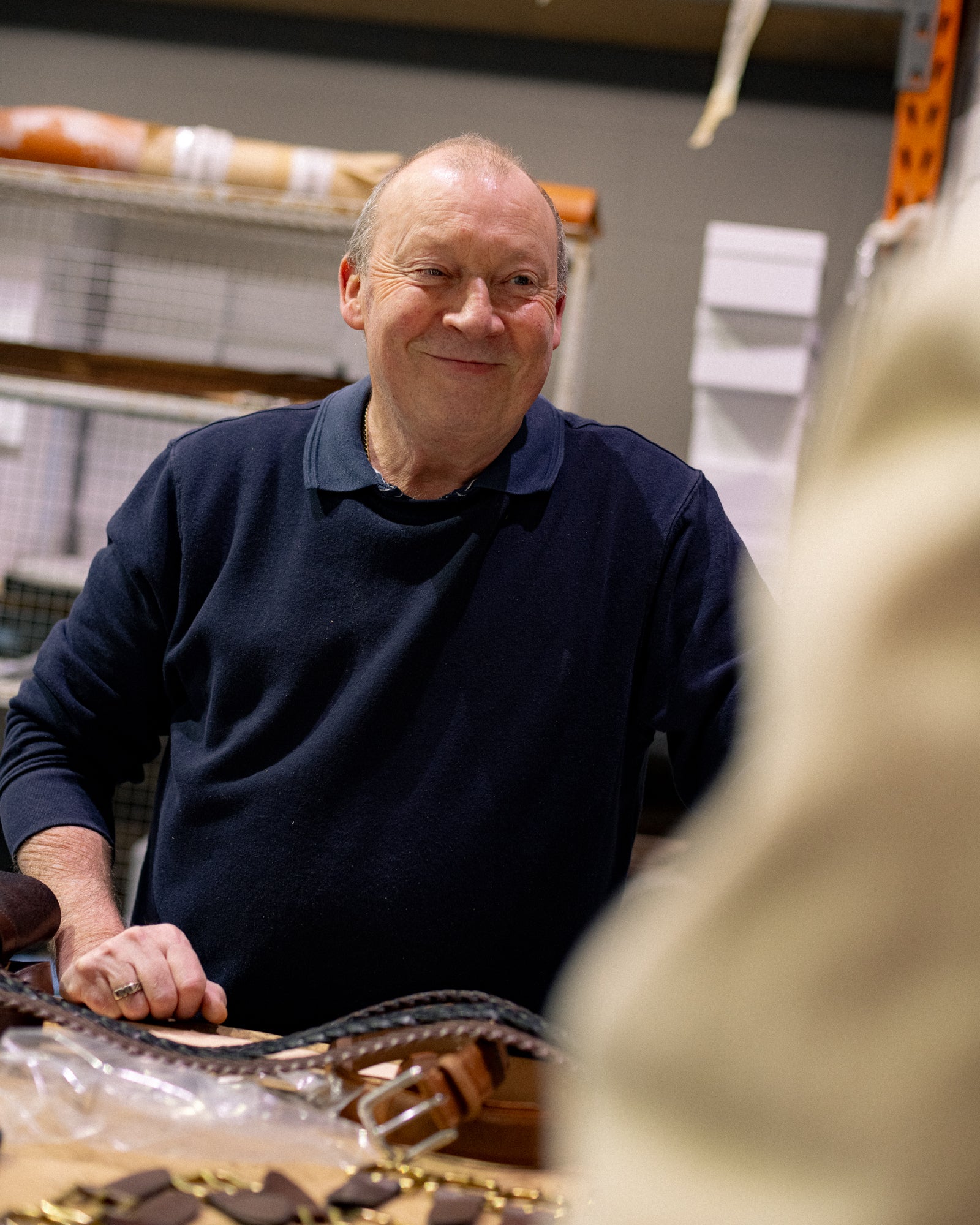
Following the successful launch of our belt range, we sat down with the person behind bringing belt production to life at Crown Northampton, Adrian Howes. With over forty years in the trade, Adrian brings an extraordinary depth of experience, and we consider ourselves extremely fortunate to work alongside him.
Our work would not be possible without the skills, expertise, and people behind it, so it felt important to put the focus where it belongs. We spoke with Adrian about his career, his journey into leatherworking, and his recent move into working with Crown Northampton.
Adrian Howes
Belt Maker
So Adrian, let’s start with the obvious. What was your first job in the trade? Where did you begin in the world of leather goods?
Let me think. I was a landscape gardener for the council, then became unemployed for one reason or another. A friend of mine worked at Regent Belt Company near Walgrave, just north of Northampton, and he got me a job there. That was about forty years ago. I was 24 at the time and I’m nearly 65 now, so it was a fair while ago.
There aren’t many people who can say they’ve spent forty years in the same trade.
Well, I just like doing what I’m doing really. It’s as simple as that.
Learning the Trade
What were you hired to do in your first role?
At first, I was cutting webbing material. It comes on a roll, I’d pull it to length and chop it with a little guillotine. I did that for a while, then moved up to become supervisor of cutting, running the whole cutting room. Later on, they asked if I fancied trying to make samples. I started doing that on overtime, and it went from there.
So you were learning sewing and construction alongside your daily work?
Yeah, it was all learnt on the job. By the time I became Supervisor of Cutting, I already knew how belts were made just from being around the factory. If I didn’t know how to do something, my supervisor would do it for me the first time. Then I’d carry on. Eventually he said, “you’ve seen me do it enough times.”
There was no formal training. You just pick it up. Every leather is different. You can teach someone how to make belts, but you can’t really teach feel. Some leathers are thin, some thick. It’s trial and error.
Northampton Roots
Any family in the leather trade?
Loads. It’s Northampton, isn’t it? Back in the day, everybody worked in the boot and shoe business.
You’re closer to that world again now. How are you finding working at Crown Northampton?
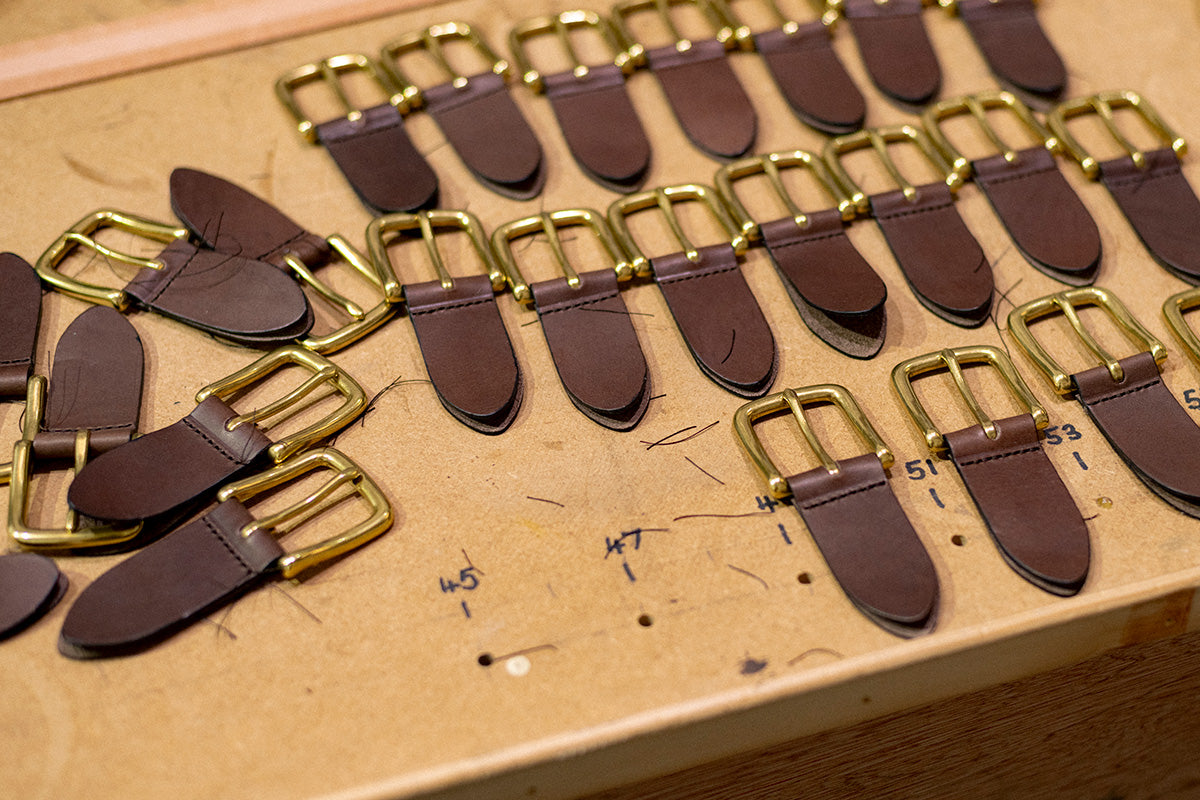
I’ve never worked anywhere like it in my life. I quite like working here. I like the way Chris does things, he’s not your average guy. Most of the leathers I’m using now, I’ve never used before. Shell Cordovan, for instance — about £200 a skin. I love cutting it, knowing you’ve only got one chance to get it right.
Production & Process
Are you working on stock or made-to-order belts?
I’ve got thirty belts to do for next week on my job sheet today. We’re not producing large stock quantities. The leather is prepared at longer lengths, then cut down when orders come in. They’re made-to-order like the sneakers, just with a bit more preparation upfront. I’ve not really worked like this before, but it makes sense given the leathers we’re using.
How do you think the leatherworking industry compares today to the past?
It’s dying really. Crafts are dying out and not many young people are coming into the trade. Years ago, you could leave one factory in the morning and be working in another by the afternoon. There was so much demand. Crown is unusual now — it feels like one of the few places that’s growing.

Materials & Machinery
Worst leather to work with?
Probably the kudu leather we’ve used recently.
The Naked Kudu from Steads? Why that one?
All the marks on it. It’s nice leather and I like it once the belt is finished, but when you see the whole skin, you’re thinking “oh dear.” It’s hard to get consistent pattern marks along the belt. Hair-on leathers are tricky too. Getting a clean edge is hard, and you end up hoovering everywhere afterwards. I don’t really have a favourite, though. English bridle leathers are nice to work with.
Favourite bit of machinery?
Splitters make life easier. Getting leather evenly thin by hand is hard. Spiral cutters are great to watch as well. There are modern machines that turn a hide into a belt automatically, but when they break, everything stops. We prefer machines we understand.
Beyond Belts
Do you have a favourite leather good you’ve made?
Not really… hang on.
(Adrian rummages through boxes and returns with a leather satchel bag.)
These were samples for a shop in London. They never came back to me, which was a shame, but I’ve passed the designs on to Chris now.
Most unusual thing you’ve ever made?
We’ve made things for lingerie brands. Cuffs and chokers for goth-type customers. First thing I made after lockdown was a black leather thong. We sold a few hundred of those.
Do you wear many belts yourself?
Not many. I’ve got one I wear for work, which I made. A tan, a brown, a black for trousers, and a couple for jeans. That’s it. I’ve got boxes of belts I’m trying to sell though!

Still Learning
Is there something you’d like to make next?
We’re looking at making a shoe polish case. There are lots of things we could make. Key holders, wallets, coin pouches. I went to Yarmouth recently and made some leather keyrings while I was there. A shop owner liked them and ordered some. You never know what people will respond to.
You’ve been sampling the Shell Cordovan Floral belts recently. What do you think of them?
I love them. I’d never used Shell Cordovan before. I can’t believe how expensive it is, and that it takes six months to make. I didn’t even know it came from a horse until I started working with it here. You never stop learning, and I think these belts are a bit special.
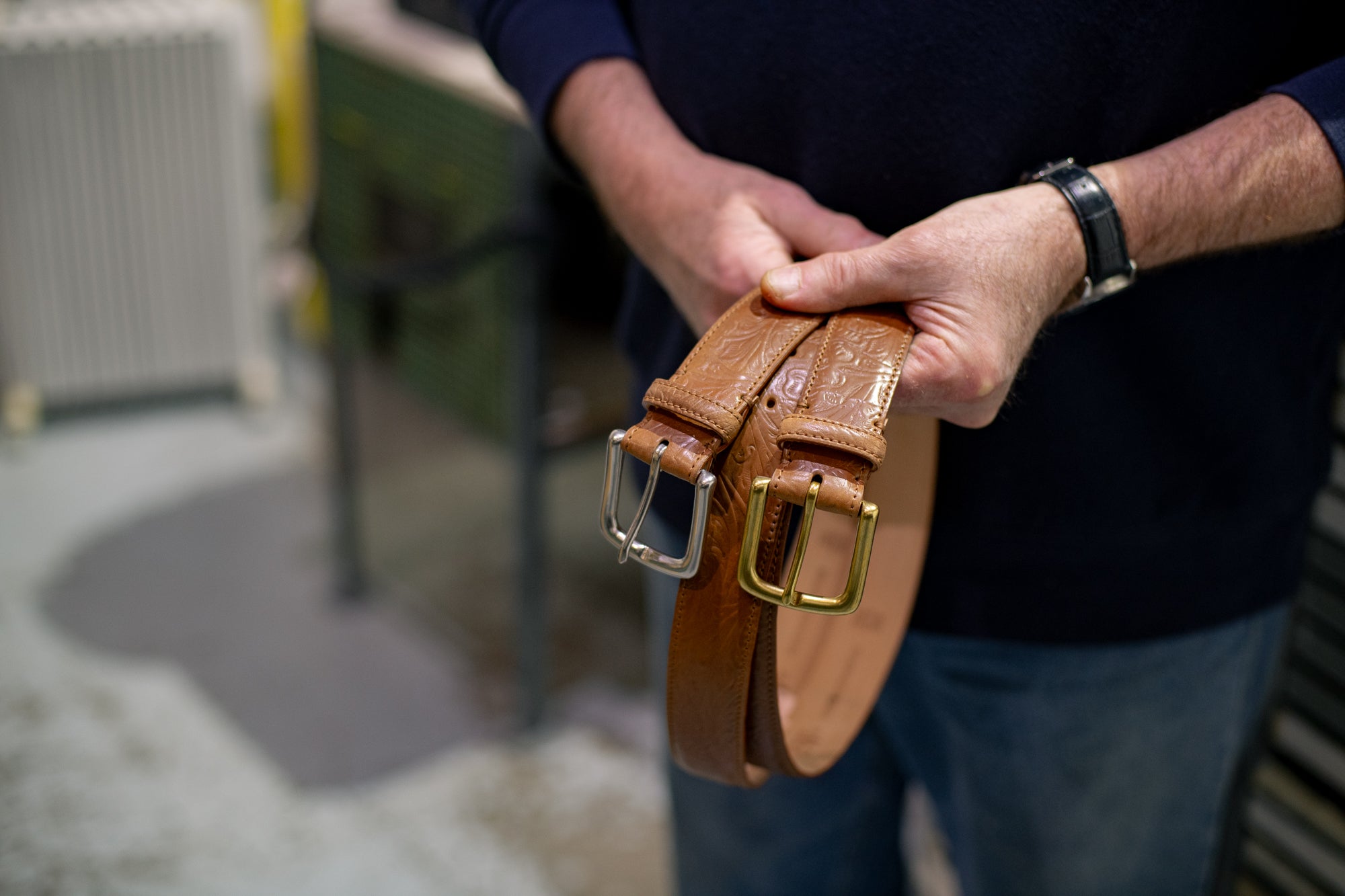
Adrian returned to the workshop shortly after, back to the bench and back to work. Forty years on, still learning, still refining — and still enjoying the process.


